Showing posts with label Henrik. Show all posts
Friday, November 15, 2013
New Thomas Kluge Portrait of Danish Royal Family: "Celebrating" 150 Years Today of the Glucksborg Dynasty: Boganborg Kids Are Gargoyles, Schackenborg Gets Off Easy, All Are Oblivious to the Destruction of Civilisation Behind Them (and Because of Them?): Symbolism, Ho!
Presented without commentary, although it should be noted that even The Fug Girls couldn't let this one pass. Commemorative book can be purchased here: Saxo
The Laurits Tuxen painting that inspired the new portrait, that of the family of King Christian IX at Fredensborg, with all children and grandchildren:
Friday, November 8, 2013
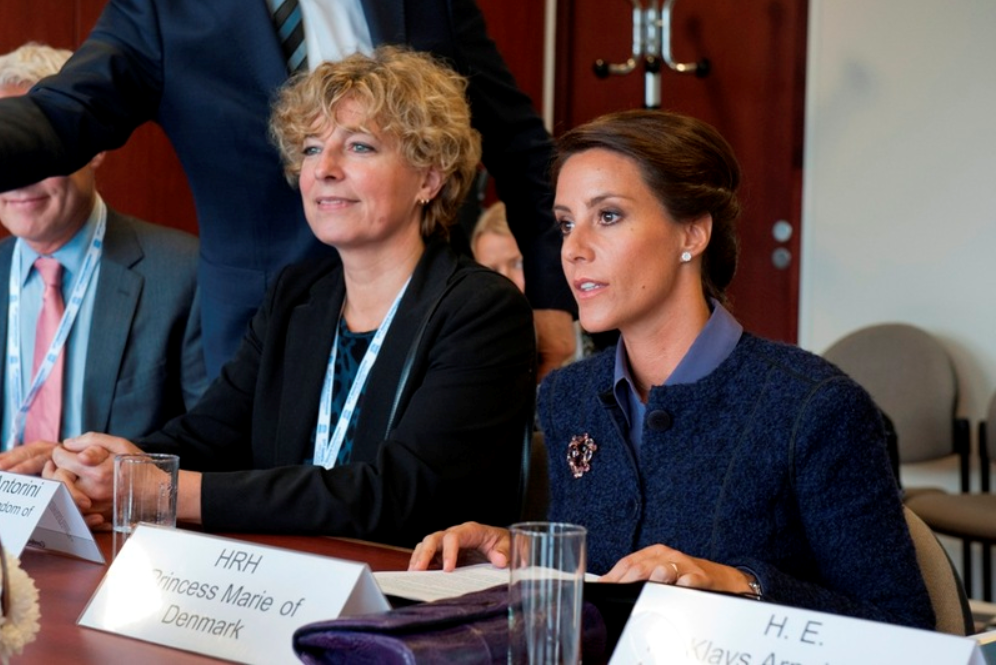
Bien Jouée!: Princess Marie Speaks in Front of UNESCO Assembly in Paris While Rest of Family Attends Daisy's Annual Fredensborg Concert
Grander audience than Madam La Sauvatrice du Monde!
So, the Danish princess who is least likely to embarrass herself and most likely to rise to the occasion was sent to Paris with her patronage UNESCO to give a speech on global sustainability. Madam Mazza, who tried SO HARD to impress herself upon the New York celebrity stage recently by dressing "cool" (ahem) and being hip and off the cuff ("yeah!") and dragging poor pregnant Princess Madeleine around to be her celebrity/royal intro to meet assholes like Bono, instead of working hard with her patronages or MEMEMEMEME Foundation and learning about the rotten issues in the world and using her influence to make positive changes. Didn't work. Yeah.
But Marie seems to be in control of both her subject knowledge and - inadvertently, which makes it more charming - her brand. Sister is not back in Paris to rub her former countrymens' noses into her marital success on an ill-fated Regardez-Moi! Tour. She quietly returned to her birthplace as a professional from her new nation, speaking on a subject that needs gracious, royal attention. She put her hair up, put on a pretty pants/blazer combo (someone get her a clothing budget!) and calmly and seriously, got on with business, not with posing for cameras.
Meanwhile, Daisy's annual concert at Fredensborg in which she typically signals all sorts of familial imbalances, was held without Marie in attendance, though Joachim made a dashing appearance in a velvet evening jacket, a dandy like his father. Daisy was all sorts of discombobulated with her belle-fille bien aimée not present - and it showed. Mary took note of the absense, as well, swanning her way into the palace in her silly sparkly dirndal skirt and recent Aussie top. Separates just make you look like a secretary on a night out, Mary. Pick out something more sophisticated, already. Fred looked like his usual bedraggled and bedrugged self, barely putting up with Mary and the requirement to attend one of his mother's cultured functions. At least Joachim was there looking relaxed and alive, representing Schackenborg, the preferred branch of Daisy's family tree.
Video: YouTube
**********
Wednesday, October 23, 2013
Queen of Deception: Trine Villemann's Fabulous Poison Pen Recounts the Tale of "Crown Prince Franz" in an "Anonymous" Kingdom in Northern Europe: All Characters in This Story MAYBE MIGHT MAY Be Based on Actual Persons: You Decide, Dear Readers
(Don't have a Kindle reader, you say? No problem! If you have a smart phone or tablet or PC, you can download the free Kindle app. Takes two seconds. From there, you can purchase an e-book that will be downloaded directly - wireless! - to the Kindle app for your reading pleasure.)
The story may (MAY) seem somewhat kinda familiar to you if you've been following this blog and/or Royal Dish for a while. Something about a spineless jelly fish whose mother is queen and spins some lies to keep up appearances which might normally be harmless as it's mostly all about the theatre of royal public life but then it hits our widdle protagonist hard in the gut causing severe pain that he is unable to treat either because he won't speak up and/or some weird macho can't-show-weakness thing from his tough daddy and/or because the evil, greedy succubus who latched onto him with the queen's help like a leech on an open wound prevented him from doing so and/or the Grey Men (TM) won't listen to him so then he starts drinking carousing and cavorting in most unroyal ways as the downward spiral continues. JUICY! Imagine if such a story were real! Oh wait!
As longtime readers, many of you know Trine well, and how she does not pull punches. Our girl is sharp-tongued, direct and not an enabler to BS. Her previous books have been a hit in both Danish and English, "1015 Copenhagen K" and "The King and Queen of Greenland". Now that you have that Kindle app, go ahead and download the book that Mary wanted banned! Well done, Trine!
Additionally, Trine's husband Malcolm Brabant has his own story to tell, and it is one of the most riveting true stories you'll read. "Malcolm is a Little Unwell" tells the story of Brabsie's decent into madness following a yellow fever jab. With humour and deep insight, Malcolm paints a stunning portrait of his and his family's life in Greece, Britain and Denmark before and after this tainted inoculation and the emotional toil it took on husband and wife, and their young son. Please support Malcolm and Trine's good works and ongoing legal struggles against Big Pharma by purchasing a few great reads for the upcoming weekend. What, you've got to have something to do while Mary's choosing which of her new freebie frocks is best for her Big Aussie Evening on Sunday!
Link to Purchase E-Book: Amazon
Queen of Deception is the first novel by Danish royal author Trine Villemann. It’s a scandalous tale which focuses on the death bed regrets of the Queen of a small anonymous northern European kingdom, as well as the self destructive escapades of the country’s Crown Prince Franz.
Queen of Deception offers a dire glimpse of life behind the Palace walls, where the cancer stricken monarch, a victim of the most horrifying cruelty, has sacrificed her own happiness in order to fulfill her royal duty. Prince Franz is determined not to follow in his mother’s footsteps.
Sensitive and weak Franz is a reluctant heir to the throne. After a miserable childhood, living in fear of his strict and violent father, Duke Alfonso, and ignored by his cold mother, Franz fights tooth and nail to avoid his royal responsibilities. He seeks solace in alcohol, drugs and casual sex, and alarms his minders by surrounding himself with a sometimes criminal entourage. Franz falls in love with a nurse, but his desire to marry her is thwarted by the Palace and he ends up succcumbing to a highly ambitious foreign commoner called Vicki.
In her final days, the Queen realises that the web of deception she has spun is about to undermine the very institution that she has spent her life trying to protect.
Trine Villemann has earned a reputation as a controversial critic of Denmark’s Royal Family. Her first book, 1015 Copenhagen K, which exposed Crown Princess Mary’s in-laws as being a family of dysfunctional freeloaders, was a best seller in Denmark. Her second book, the King and Queen of Greenland, argued that Crown Prince Frederik and his Australian wife should go on an apprenticeship to Greenland so that they could prepare for the day when they would inherit the throne from Denmark’s Queen Margrethe.
Wonder if the e-book's sexy "nurse" character (excellent! nurturing and care-giving, just what Freddles needs) bears any resemblance to this young woman? RIGHT THIS WRONG, FRANZ!
Friday, October 18, 2013
Politiken Reports That A Monarchy Expert Claims The Danish Royal House Is A Modern Media Dynasty, But the Cracks in That Facade Are Too Obvious
Real messaging going on regarding the Danish Royal Family in thissie! Lots of food for thought here! Speaks directly to the royal facade and how it's not always going so well. They speak fairly directly about Fred and Yrma's "marriage" and about how tradition says you fake it so you make it. Well, so much about doing what's right for Derfie's health and chucking Madam into the drink! This gives a good history and backgroud to the sycophancy that happens even to this day. They remind that when Daisy and Henri got married, there was only one TV channel, so naturally, 8 hours of a grand wedding will tick off the republicans and forever charm the romantics of the nation.
Very insightful observations here, too. The royals have always been clueless about being "normal"! And they are absolutely right that the very things many of us love - photies of them all glammed up at weddings and galas and the candids at the Olympics and other biggie occasions - are the very things that contribute to them being party hounds who have no worry in the world except how to match their dress to their blue Elephant Order ribbon. Pas på, Daisy!
Article: Politiken
The Royal House Is a Modern Media Dynasty
For over 150 years, the royal family lived by and with the great media exposure
by Jes Fabricius Møller, Associate Professor of History at Saxo Institute, University of Copenhagen , specialising in European monarchies recent history, in particular
Frederik IX and Queen Ingrid were characterised by the fact that they already as the crown princely couple had developed a much more active relationship with the media than we had previously been accustomed to.
It was much more common to see pictures of the royal family in everyday situations, it became an increasingly central feature of the royal family to represent values that the average Dane could identify with.
In 1949 the School of Radio was invited inside Amalienborg at the home of the young royal family. Frederik IX looked around it, which according to him "in fact does not differ so very much from an ordinary normal Danish home". So far so good, but the king immediately continued, "here we are on the first floor, the one with the tapestries", and so any semblance of normality with the Danish evaporated.
That error at the king's hand was not that he had tapestries hanging, but he showed no understanding that it was something special to have them. It was a mistake that did not recur. Frederik IX and Queen were generally very good at their job. Famous are the images where you can see the king hugging his wife who he could find to call Queen Ingrid, and the relationship between the parents and three daughters was also openly affectionate. Although the scenography was a royal ship or a castle, it represented the family life that many Danes either had or wanted to have.
The trend began in the early 1800s, and during the 20th century, it was an outright rarity that royal allowed him- or herself portraying the specific characteristics of their dignity: ermine, orb, crown or scepter. Family values are replaced in part the dynastic family model where the interests of national or dynastic interests prevail over the individual prince or princess . This makes it a way, still to a certain extent . But it's just as well been extremely important that royal families are also happy, or at least can pretend that they are an ideal family.
Far from all royal marriages being happy, but it helps undeniably, if there is a correlation between the real family and mediated family. For the same reason, it is essential for a modern royal marriage, there is a feeling based connection, what you call a love match and not an arranged marriage.
The public will only accept a royal marriage if it is likely that it is based on mutual and equal emotional appeal. If this attraction is not available, it is said to be essential that one can pretend. Prince Charles and Lady Diana Spencer's wedding in 1981 is a good example. The marriage was by all accounts a rational party from the beginning , and it would probably have been possible to maintain the illusion of a love match, as long as both parties had been willing to accept the premise from the beginning.
Indiscriminate pandering is not necessarily in the royal family's own interest. For the generation that Frederik IX belonged to, there was the added challenge that it was not yet acceptable for royal - and certainly not for heirs to the throne - to marry below their rank, even with nobility.
It restricted the supply of potential spouses. But at the same time there was built up in the public an expectation that the crown prince entered into a love match.
He did indeed, as he in 1923 fell for the Greek princess Olga and got his father and the Danish Government's consent to marry her. However, the slowdown of his emotions was quick, and he broke it off with her. This was no great scandal, yet enough for the Danish crown prince to remain a bachelor for many years to come.
The ten years younger Swedish Princess Ingrid was a hot topic on the European royal marriage market. She was a modern woman who looked good, smoke cigarettes and drove cars. She was in the press associated with several prominent royal bachelors, among others, the British Prince George. He ended up marrying Olga's sister, Marina, a marriage that took the European public, because the couple outwardly lived up to the ideals of the Enlightenment. Later on it was found that this is far from the case.
Also, Crown Prince Frederik was a hot name on the rumours, and he was now linked with the Swedish princess. In January 1935, Berlingske Tidende had so much faith in rumours about an upcoming engagement, the newspaper dared to put the story on the front page of the paper's width and with the greatest types: 'The crown prince engaged to Princess Ingrid'. The newspaper should not have. Next day, the humble print a retraction issued by the Cabinet office. The sweat in Sværtegade! In March of that year it was now Politiken's turn to put the rumour of Ingrid and Frederik on the front page as the main story: 'Toay at 10am the Crown Prince's engagement to Princess Ingrid was declared'. This time the rumours were true. Or you'd be better off saying that Politiken had an exceptionally good source for the newspaper and could quote a private telephone conversation between the Danish Crown Prince and his future fiancee as evidence of history. The interesting thing is that the newspaper shamelessly admitted that it had in that way slipped into the royals' private lives.
In the Politiken newspaper in Stockholm, Paul Sabroe, who wrote under the name The Golden Blonde, described the engagement as if there was a sports reportage. He took among other time how long it took the first kiss, as the fiancée exchanged at the railway station in Södertälje. This ironic approach to politics meet audience needs to get curiosity made without alienating the Republican segment among the many radical readers away.
One of the best examples of this style comes from Politiken reports from a great trip to Jutland, which Frederik VIII, in collaboration with the Head of Government, left the man JC Christensen, in 1908. Christensen had been eagerly awaiting the king's political wagon. The trip was intended to sell a defense to the Liberal-skeptical hinterland. The radicals were then in opposition, and the party newspaper had sent one of their sharpest pens, Andreas recovery that began its depiction of the royal visit to Varde as follows:
'The king arrived early this morning at Varde, where people from all over Jutland were summoned together to see him and the big agricultural fair. The town for the occasion was coated with garlandry as for the better funerals. Outside Ligkistesnedkerens Boutique, a row of Christmas trees was planted, in place of honour at the gates was placed what looked to be a heavily drunken Norwegian lion, which on closer inspection turns out to be Vardes city arms'.
For in just a few lines to associate death, burial and drunkenness, he managed to recover from the beginning an impression of a sad and amateurish performance where the royal family appeared as parallels to the show's dumb prize cows and thus powerful extras in the newspaper's campaign against the government of general and JC Christensen in particular.
It was released for the press in the early 20th century. The papers were then unfeigned organs of party interests, and the royal family were shown not spared. However, it will come as no surprise to most that one of the strongest attacks on the royal family came from told the paper. There was in 1909 created what might be called a moral panic in Copenhagen over the rumours of widespread gay sex that was spoken about, not least in the Copenhagen garrisons. The paper went so far as to hire two private investigators who examined the spread of immoral behaviour in the Regiment.
The newspaper's investigative journalism did not bear as many fruits as hoped. Only a few 'perverse males' were detected and removed. The newspaper The Social Democrat mingled and did not fail to insinuate that homosexuals like used game with the Royals and the higher nobility. Told the paper facing persistent, but indirect accusations against Prince Harald of having ties to the gay community, with the understanding that the prince himself was gay. The magazine's editor, Mr. Matthiesen, was accused of also having plastered private detectives in Prince Harald's life, which he denied.
Matthiesen ended up being charged and sentenced to three months in prison for insulting the monarchy, but acquitted of having spied on Prince Harald.
Prince Harald had to return to live with gossip about his sexuality, a fate he had to share with many other royals before and since. It is probably most famous example comes from Sweden. Gustav V paid in the 1930s large amounts of money to a man who threatened to hang the king out as gay. The case came to light after the king's death in 1950, and proved just as devastating to the King's legacy as if the blackmailer had done it threatened.
The story shows how exposed the Royals are in the modern media reality. The royal family enjoys perhaps judicial immunity, but they are brought to the public's merciless court daily.
The media revolution had begun already in the 1860s. A new technique, wood carving, allowed the reproduction of images in a high quality, large warehouses and at short notice. It was used by Illustrated Journal, Denmark's first illustrated weekly magazine, which started to appear in 1859.
The King substance filled from beginning well up in the columns, and especially the big weddings gave rise to great articles with full-page reportage images. By Frederik and Ingrid's wedding in 1935 was the radio come. There were half a million radio licenses in Denmark, and it means that almost the entire population had access to listen to todays ceremony in Stockholm, which was published in both Danish and Swedish radio.
Royal dominance in the media culminated by heir to the throne, Princess Margrethe's wedding in 1967. On the actual wedding day, 10 June, Danish television broadcasted a total of six half -hour television broadcasts. There was, as we know, only one channel then. Of them, there were a half-hour children's broadcasting and about half an hour news. The rest were broadcasting from the wedding ceremony in the Church of Holmen, the reception at Fredensborg and a Danish-French gala evening.
This means that 85 percent of its output on Danish television that day was busy with the heiress's wedding. Although today sent several hours from the royal events on the major channels , there nevertheless has a lesser impact on the ikkeroyalt minded viewers' patience because the royal transmissions represents a relatively small proportion of the total TV viewing. But even under the conditions drag king substance is still very large audiences. About half of the population follows the example. Queen's speech in one of the live broadcasts. It is quite exceptional in an otherwise fragmented media reality.
I know DR and TV2, and therefore the rates they also continue on a massive coverage of the royal events. They are usually quite critical angle to the material they cover. Benevolent presenters and experts are trying as much as possible to get three, four or five hours to go with mostly polite generalities. It is no easy or particularly grateful genre to move in.
Indiscriminate pandering is not necessarily in the royal family's own interest. If media consumers do not have anything but the photos of the big parties, it is clear that they are easily left with the impression of the royals as useless triflers who lives a life of luxury at taxpayers' expense.
At the same time the royal family as the entire public sector is facing a new era of business logic that requires result-oriented efficiency and profitability.
Do we get value for money? The task that the royal family is facing is to convince the public that they have a real feature and adds the community a real value. It is not easy.
**********
And some comments from the website:
Alpha
1. Anachronism
The Royal Family is and will be a ridiculous anachronism. And like any other anachronisms becomes more and more hilarious and ridiculous over time.Monarchy can easily be dispensed with. There is no reason that we should let it replace a president.The only real state judicial function the royal family has, is to hold a "King's Round" after an election - that is where the party leaders in turn show up at Amalienborg to point to a royal investigator who must explore the possibilities of forming a government. Margrethe says, however, just hello and goodbye - for upon entering, the respected party leaders tell the Lord Chamberlain who they will point to.This feature could appropriately be left to the Supreme Court President - and VIPs are no justification for the royal family disappearing.
2. It may be dispensed with ..."Do we get value for money? The task that the royal family is facing is to convince the public that they have a real feature and add a real value to the community. It is not easy."Our relationship with the royal house as well as our relationship to smoking in restaurants and discos in the 90s: inconceivable that it could be abolished - but now that it has happened, unthinkable that it can be inserted ...The monarchy rests on a habit. Habits are hard to change, but the new generation of monarchs have , with their luxury life and manageable tasks that do not add real value to society, made the first step.The monarchy door will shut with Margrethe II, but the media will probably keep it alive for many years after, because there is money in the shit.
2a. Answer: They are dispensable ...
I can easily follow your post here. But then I could well imagine and know what you want as an alternative to the Royal Family. For you must not tell that it will be cheaper by a president or the like. I am unfortunately here in "the same ditch."
2b. Answer: They are dispensable ...
For me the price is not the most important thing. A president can act politically and comment as well. It is what we choose her or him, and it involves significant tasks that have real value (hopefully, otherwise we trip over him / her).Finland and many other countries are doing brilliantly as republics, and the royal family has never been able to demonstrate real value.
2c. Answer: They are dispensable ...Of course a president is cheaper. One should not pay the whole the presidential family - and since you generally chooses a politician who through many years of seem has earned the reward to the record, it is also limited, how many years he or she subsequently must have a pension. A president need not be selected through an animalistic election campaign. One can for example use the German model, where the President is appointed. Some object that it is undemocratic. But the royal house is also.
The Royal Family is and will be a ridiculous anachronism. And like any other anachronisms becomes more and more hilarious and ridiculous over time.Monarchy can easily be dispensed with. There is no reason that we should let it replace a president.The only real state judicial function the royal family has, is to hold a "King's Round" after an election - that is where the party leaders in turn show up at Amalienborg to point to a royal investigator who must explore the possibilities of forming a government. Margrethe says, however, just hello and goodbye - for upon entering, the respected party leaders tell the Lord Chamberlain who they will point to.This feature could appropriately be left to the Supreme Court President - and VIPs are no justification for the royal family disappearing.
2. It may be dispensed with ..."Do we get value for money? The task that the royal family is facing is to convince the public that they have a real feature and add a real value to the community. It is not easy."Our relationship with the royal house as well as our relationship to smoking in restaurants and discos in the 90s: inconceivable that it could be abolished - but now that it has happened, unthinkable that it can be inserted ...The monarchy rests on a habit. Habits are hard to change, but the new generation of monarchs have , with their luxury life and manageable tasks that do not add real value to society, made the first step.The monarchy door will shut with Margrethe II, but the media will probably keep it alive for many years after, because there is money in the shit.
2a. Answer: They are dispensable ...
I can easily follow your post here. But then I could well imagine and know what you want as an alternative to the Royal Family. For you must not tell that it will be cheaper by a president or the like. I am unfortunately here in "the same ditch."
2b. Answer: They are dispensable ...
For me the price is not the most important thing. A president can act politically and comment as well. It is what we choose her or him, and it involves significant tasks that have real value (hopefully, otherwise we trip over him / her).Finland and many other countries are doing brilliantly as republics, and the royal family has never been able to demonstrate real value.
2c. Answer: They are dispensable ...Of course a president is cheaper. One should not pay the whole the presidential family - and since you generally chooses a politician who through many years of seem has earned the reward to the record, it is also limited, how many years he or she subsequently must have a pension. A president need not be selected through an animalistic election campaign. One can for example use the German model, where the President is appointed. Some object that it is undemocratic. But the royal house is also.
Saturday, October 12, 2013
Pas de Deux Royal: Daisy and Henri at ARoS Museum To Open Dual Exhibit of Their Artistic Pursuits: The Cultural Queen Will Give Way To The Alcoholic Depressive Sportif King Derfie X
"Look, chéri! It's the piece you did of my engorged twat! Right by the painting I did of my "love well" on our wedding night!"
Today, Henri and his Daisy opened a long awaited exhibit at the ARoS museum in Aarhus called 'Pas de deux royal'. It showcases their individual artistic efforts, including Daisy's painting, vestry clothing, and découpage and Henri's sculptures and poems. Berlingske's reviewer gives it 4 out of 6 stars.
Daisy and Henrik have highly erotic sensibilities, as their cooperative efforts easily showcase. Henri may still even physically satisfy Her Majesty from time to time, in a grand gesture of noblesse oblige, and one that may not even be too horribly unpleasant for him despite all the gay/bi rumours. Henrik knows who butters his bread! Besides, these two seem to have a connection that goes beyond the physical.
Which just places Derf and Yrma in a further horrible light. Daisy is such a little devil. Royal to the end, she will eventually have MoreMore falling hard on a sword of her own making, right in front of Daisy as our old girl smiles her sweetest smile, then blows out smoke from one of her eternal fags over the ruins of Madam. Mary is not in the least bit artistic, cultural, interesting or interested. Mary cares about Mary and is sucking the life out of Daisy's artistic son. Derfie's the one with the more emotional, artistic character, while Joachim is more rational and verbal. Clearly. But Fred knows about design and art and even if his taste in music stopped developing at age 17, he is the only cultured one in the clown prince couple. Surely Daisy wished Mary would develop interests in particularly Danish artistic pursuits, it's a country with so much to offer, once she was accepted into the seraglio, given a life of comfort and security, coddled and bowed to. But a monster was created instead. Now Daisy has to give Yrma enough rope with which to hang herself, and this little celebration of Daisy and Henrik's mutual love just further underscores the sorry, rotten bags of goods that Mary turned out to be. As the Berlingske art reviewer says in the review below, "it is also essential that Danish society has a royal couple who take art and poetry seriously." Pas på, Mary! Watch out!
**********
Interview: TV2 East Jutland
**********
Exhibit webpage: ARoS
ARoS is very pleased to be able to present a unique exhibition featuring Denmark's creative Royal Couple.
12 October 2013 – 23 February 2014
The exhibition, PAS DE DEUX ROYAL – an artistic meeting, includes some 150 works selected in close collaboration with H.M. the Queen and H.R.H. the Prince Consort. The exhibition contains both early and very recent works and the artistic themes have been divided into 10 galleries covering a total area of 1,000 square metres.
The Royal Couple's lifelong fascination with the visual arts ran deeper than mere interest, since they both, all along, have had an active career as creative artists. PAS DE DEUX ROYAL – an artistic meeting has been organised as a retrospective dialogue between the multifarious works of the Queen and the Prince Consort, respectively, and museum visitors are invited to enter a universe far removed from the Royal Couple's traditional and representative activities.
The exhibition portrays the Queen as a landscape painter, but visitors' eyes will also be feasting on church textiles, large theatre stage sets, and the meticulous découpages, to which the Queen has devoted herself for a number of years and which have added further edge to her creative talent.
In the case of the Prince Consort, it is sculpture and poetry which repeatedly find new modes of expression in imaginative bronze and marble figures and a flow of poetic diction.
The exhibition galleries render a visualisation of a long life shared and common experiences expressed through creative talent in their own ways and in different media. The Queen is fascinated by nature in its glorious magnificence, never leaving room for figures in her art while the Prince Consort always focuses on animal and human bodies in his sculptures, and his frequent use of the words 'you' and 'I' in his poems serve to underline human relations.
With themes like nature, love, fantasy, and religious aspects, the multifaceted art of the Royal Couple is filled with varying moods and expressions. Under ten headings covering the ten exhibition sections, the Queen's and the Prince Consort's works enter into a mutually conducive dialogue – gallery by gallery.
To mark the exhibition, PAS DE DEUX ROYAL – An Artistic Meeting, ARoS has published a richly illustrated 220-page book with new photos of the Royal Couple and of their numerous works.
Seven authors elaborate on the Queen's and the Prince Consort's artistic production whilst also placing the Royal Couple in an overall culture-historical perspective. The book is available in Danish, English, and French from the ARoS Shop and costs DDK 299.
**********
Review: Berlingske
The Royal Couple's Exhibition at AroS Shows a Couple Who 'Can't Help It'
The exhibition at AroS of the royal couple's paintings and sculptures, church textiles and poems gives a picture of two people who can not help but work with various forms of artistic expression - and fortunately one another to share it with .It is said that all children draw. It also appears that the vast majority of them stop. Some, because adult life institutions destroy creativity. Others are discouraged because they become aware of what real art looks like. Still others simply take on new interests.But then there are some who will know, because they can not stay away from it, that drawing or painting or molding or compiling things into something that is what we usually classify as art.The very first picture in Queen Margrethe and the Prince Consort's first joint exhibition that appears on ARoS Art Museum in Aarhus, is a very small study of a vase of marigolds, as the then only seven Danish Princess Margrethe painted in 1947.
It was a set piece. Along with other students, the princess was asked to look at the subject and try to maintain it. The little paperwork is perhaps included because it appears to be a harbinger of the joy of creating images were stronger and more persistent for the young princess than for most others. But she had to repeatedly get her scruples, if it really was something, or could be anything; what she - with her own expression - went and 'tampered' with.
In the first of a total of ten rooms that make up the 'Pas de deux royal - an artistic meeting' , you will find several examples of other early works, which refers to one of the cases where there is a giveaway for an exhibition of this kind where you put two artists in dialogue with each other because they think they have more in common than not.
It turns out that the royal couple, long before they met, both tampered with porcelain paint. She in Denmark and he 'out there east of Suez', in the words of the old song. They showed copies is as of a later date, but they are still an almost fate-fitting entrance to an exhibition that through a variety of examples tells of two people who also meet and redeemed in an artistic collaboration. They translate together. She illustrates his poems. They experience the world together and inspire each other in an ongoing conversation where very different cultures and traditions meet. But the result of their artistic creations does not begin to resemble each other.
As in all matters relating to the royal family's meeting with the public do, the Queen of course plays the main role. It was also the Queen's pictures, the public earlier became acquainted with when she was originally invited to exhibit for the first time in the arts institution's walls. It was in the Køge Art Museum of Sketches, and it was in 1988.
There has been a lot since. The ARoS exhibition is partly chronological, so it starts with the first fumbling attempts with the illustrations for JRR Tolkien's book 'Lord of the Rings'. It was also at this event where it started to get serious for the Queen with visual art. As others also had done she obviously looked at the art that surrounded her, and thought that she never had really gone there.
It may also be difficult. For most artists, it's a full-time job to work on their art. One thinks of it most of the time. One must make numerous considerations and experiments to get the result to look as though it is straightforward and obvious. One must know the tradition and keep themselves updated with the time.
It eventually is something of a challenge for the royal couple, but they are - say museum directors in all parts of the country - very well informed about art. And then both the Queen and Prince Consort the advantage that they have had the best advisers.
The painter Preben Hornung was one of those who could give Queen Margrethe a decisive impetus because he had the integrity to say what did not work, and what had potential. The Prince Consort had good support for his larger sculptures in Bjørn Nørgaard, whose idiom is apparently because, in flashes they have a knock-on effect and the Prince Consort's early sculptures were with the help of Poul Holm Olsen, who was a lovable and highly competent senior lecturer at the School sculptor. It is also his distinguished collection of African art, which at his death will be donated to Holstebro Art Museum. And just African masks that have had such importance to European art in the 20th century, they have been a significant underlying inspiration for the Prince Consort, together with the non-figurative modernist sculpture and its abstract idiom - when the Prince Consort when not create an ostentatiously figurative sculpture.
On the whole it is seeking through with the royal Artists Couples. Curiosity and hungry for images is kept intact. The exhibition through brands to openness to other artistic expression and the desire to fantasise. Also the lyrics of Prince Consort case. With set design, church textiles and découpage the Queen. Découpage is something different from the collages, although the result can immediately remind you of the other. It is in the Queen's own words a real 'cut and paste' project. You place images - sampled or appropriated from anything - on an object so that they have a decorative character, and then the objects - for example a tray or trash can - are painted many times. Many, many times.As in all other appropriation art originates images from different cultural groups, but there is a tendency for church interiors and bishops' cloaks among the Queen's favourite subjects, and it endows the finished images with an adventurous mood, of course exacerbated coherent series of images inspired by for example, 'Snow Queen' and 'the Wild Swans'.
Among some of the Queen's older works in the exhibition is a series of watercolors entitled 'Landscapes of lost legends'. They are important for the coherence of the work because they suggest a recurring theme in the Queen's pictures and anticipate the series which is still the Queen's most original and a masterpiece of her generation. But first the queen's hold on some of her motives for this are obvious. Just outside the window. Just outside the park. In some of the pictures you can feel the reverberations of Danish modernism, but mainly it's pretty, slightly melancholy images of fine cultured parks, which in a way correspond to one of Prince Henry's poems (here in Per Aage Brandt's translation ) that despite framework provides a glimpse of something quite human: It's an experience you can also have of the Queen's pictures of the surroundings.
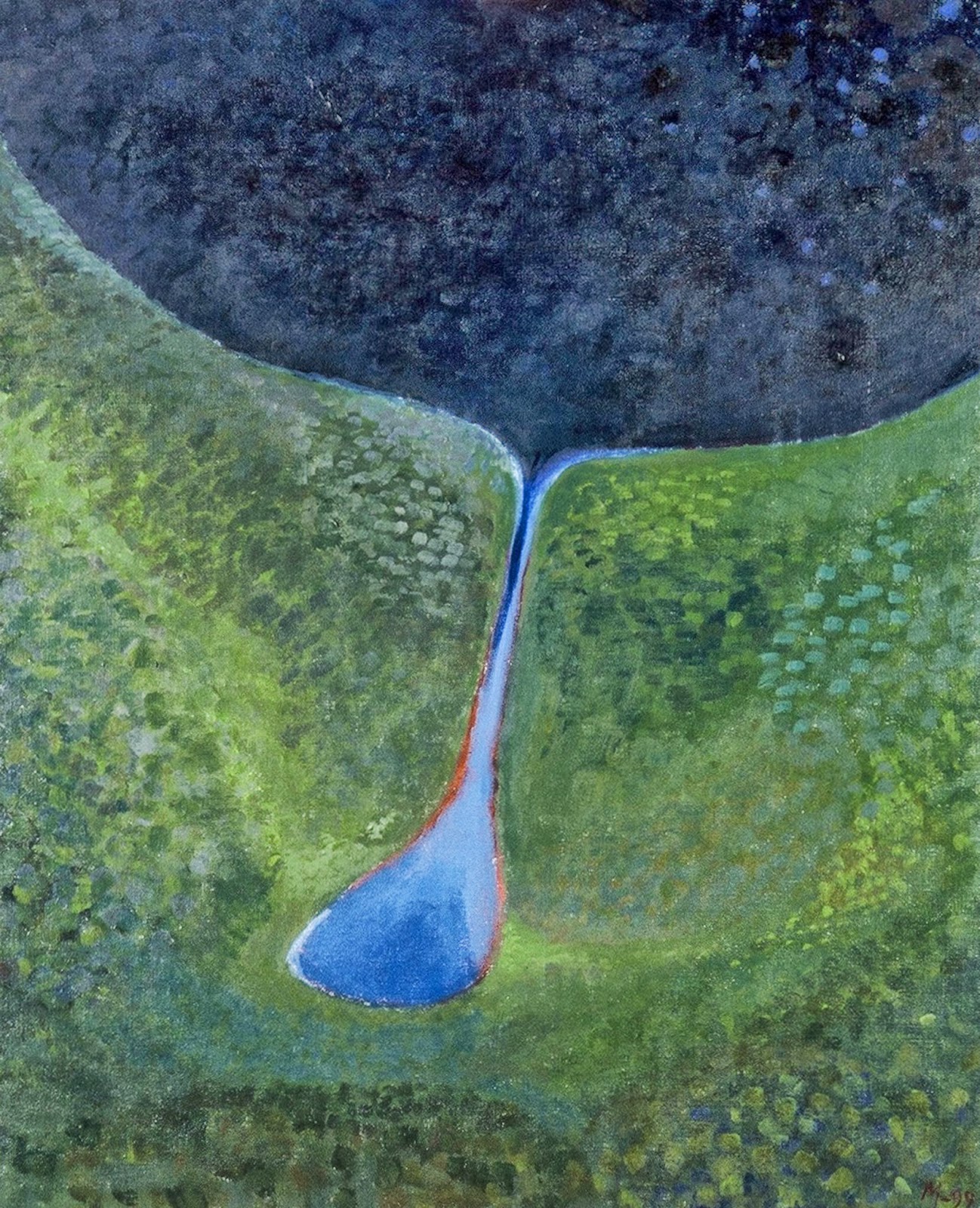
Around the turn of the millennium, however, something crucial happens in Queen Margrethe's painting. Queen Margrethe is not the first royal who has "tampered" with art. Prince Eugen of Sweden is another, very famous example. And in the late 1990s Art Brandts in Odense suggested a dialogue exhibition between the two. The invitation struck Queen Margrethe's artistic nerve. Maybe because Prince Eugen was so respected by his contemporaries and for that matter still is canonised as a good painter. The result was the series 'From the outer mountains', which in many ways is quite different than anything that Queen Margrethe had previously painted. As the early legends pictures, this series of paintings are consistently kept in green and blue shades, in capricious landscapes. Human-free landscapes. They look like some sort of sum total of Nordic landscapes, but the unique and interesting about them is that the Queen so to speak, found or invented newly discovered land by painting through her internal images of the landscape and all the way to the coast. Without necessarily having a clue as to what she would encounter along the way. Or how subsequent paintings would be.
It is a lush landscape the Queen portrays. Not without sexual undertones. But you basically do not know if it's just desolate and forsaken man, whether it is a primeval landscape, or the landscape after we are gone, and nature is by winning back and heal the planet. It is a series of pictures that are very open to interpretation - but the consequence is also that the Queen so to speak, had to discover for herself what was on the other side of the landscape of deep fjords and soft peaks. Just by painting through and out of the water at the end of the world.
There was not a boat and waited and allows for new opdagelsesrejserpå the other side of the world's end, so the Queen left off consistently subject and threw himself into new and stones and bones and the heretical art historical motif flower. As Prince Consort think the Queen to be in constant alternation between figurative and abstract images.
The suspension works more places very well. Especially in a dark room with memento mori-like sculptures (among other things, created in collaboration with jewellery designer Torben Hardenberg ) and one in the room devoted scenography that, the Queen's work taken into account, must necessarily have an uplifting character. And although it may seem that the heavy and serious image "Cloud and Violence" in 1997, which - perhaps - is inspired by the dramatic events elsewhere on the European continent, can be placed in a religious context, together with a number of the Queen's bishop will not find the space and quiet, it requires. Surrounded by mirrors and colorful church textiles.
Opinions are always divided on the Queen's exhibits. Some would argue that such an exhibition using space and time that could have been used for others and - implicitly - a better purpose. While others on the other hand, argue that the audience-magnetic exhibitions of this kind - and there are precedents where they have been crucial to a museum's economy - enhances interest in art.
But in any case it is also essential that Danish society has a royal couple who take art and poetry so seriously that it is very important in their life, work and interests. And they simply 'can not resist' it, as the Queen is quoted on the wall near the small image that opens the exhibition.
Daisy, Marigolds in a Glass Bowl, aged 7
Prince Henrik, Torso, 1970
Torso
Prince Henrik, Krucifiks
Prince Henrik, Open Heart
Daisy, Bishop's robes, Aarhus Cathedral
Daisy, Transfemmeren II, 2013.
Daisy, Snow Queen, 1997-1999.
Dråbsøen, 1999.
The Green Field, 2002.
Bænk, Marmorhaven, Fredensborg. 1983.
Slotsallén Fredensborg, 1971
Photos: Henning Bagger (exhibit); Peter Jensen; Hofmarskellet; Anders Sune Berg; Jacob Jørgensen Film; Torben Eskerod; Dorte Krogh; Jens Dige/Polfoto; Poul Ib Henriksen; Ole Hein Pedersen
Subscribe to:
Posts (Atom)